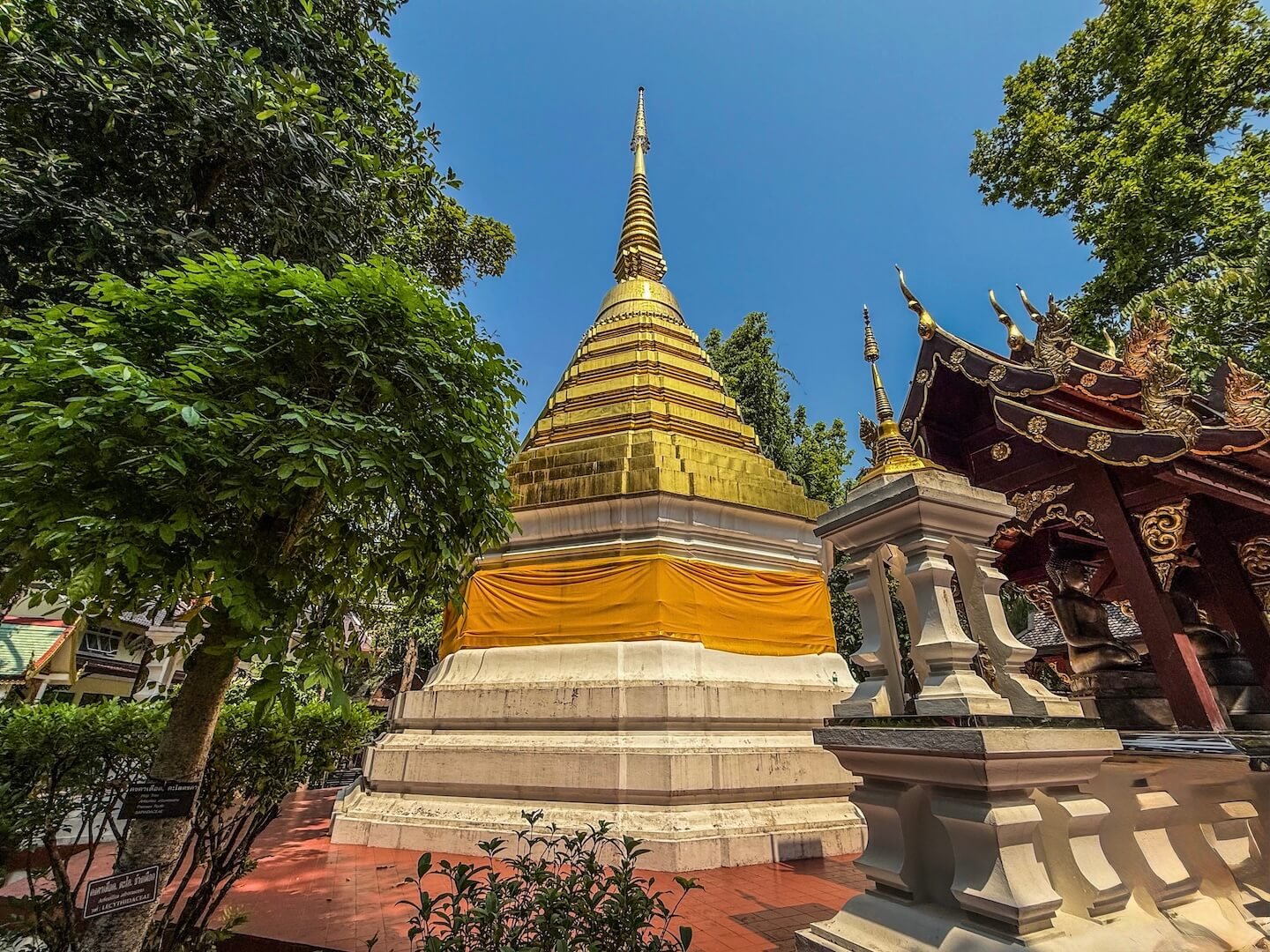
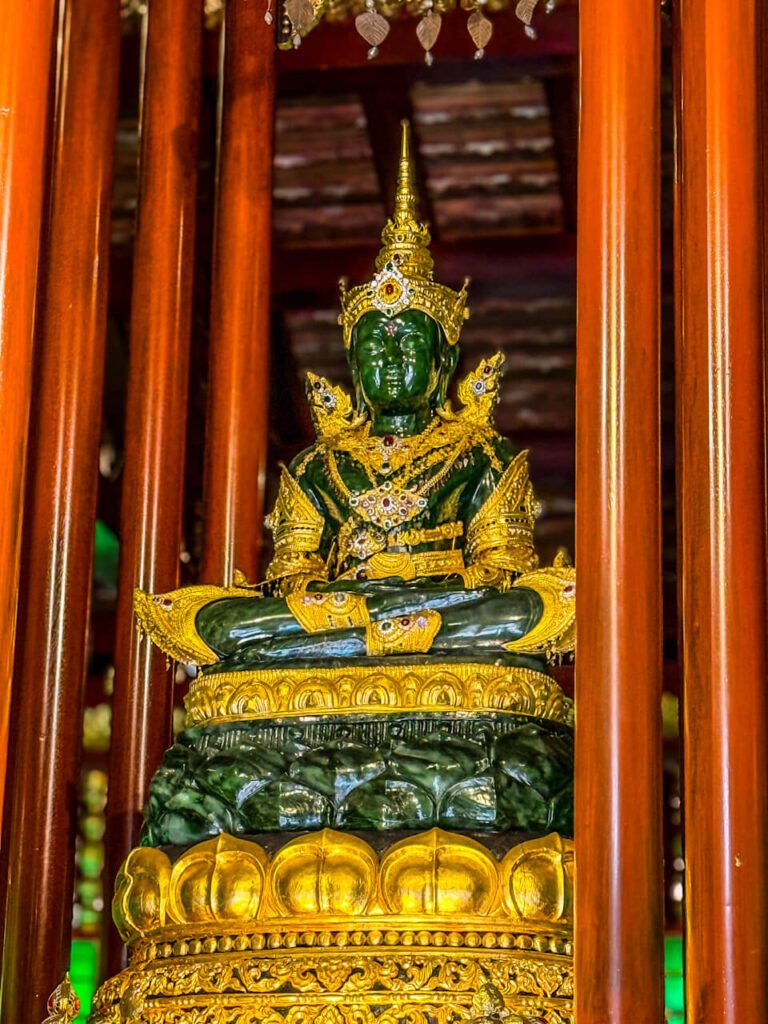
The Emerald Buddha, or Phra Kaew Morakot, is Thailand’s most revered religious icon—a symbol of national identity, spiritual protection, and royal power. Though small in size, this exquisite green jade statue has traveled across kingdoms, survived wars, and witnessed the rise and fall of empires.
Its story begins not in Bangkok, but in the northern city of Chiang Rai, where it was unexpectedly discovered in 1434 after a bolt of lightning struck a stupa at Wat Phra Kaew. What seemed like a damaged clay statue revealed something extraordinary beneath—a gleaming green Buddha image, destined to become the spiritual heart of a nation.
From Chiang Rai to Lampang, Chiang Mai, Luang Prabang, Vientiane, and finally Bangkok, the Emerald Buddha’s journey reflects not just the spread of Buddhism, but also the shifting political and cultural landscapes of Southeast Asia.
The timeline below traces this remarkable journey—a path shaped by faith, fate, and history.
Timeline of the Emerald Buddha
- 1434 – Chiang Rai: The Discovery
A lightning strike hits a stupa at Wat Phra Kaew in Chiang Rai. The outer stucco of a Buddha statue cracks open, revealing a green figure underneath. Upon further examination, it’s found to be carved from jade or green jasper—soon to be known as the Emerald Buddha (Phra Kaew Morakot). - 1436 – Moved to Lampang
The statue is transported to Lampang, where it is enshrined at Wat Phra Kaew Don Tao. It remains here for 32 years and becomes a highly venerated object in the Lanna Kingdom. - 1468 – Chiang Mai
King Tilokarat of the Lanna Kingdom moves the Emerald Buddha to Chiang Mai, the capital of Lanna at the time. It is placed in a specially built sanctuary at Wat Chedi Luang. The Emerald Buddha stays here for 85 years. - 1552 – Luang Prabang (Modern-Day Laos)
Due to political upheaval and the rise of King Setthathirath, the Emerald Buddha is taken to Luang Prabang, the capital of the Kingdom of Lan Xang (Laos), when the Lanna and Lan Xang kingdoms are briefly united. - 1564 – Vientiane, Laos
The Emerald Buddha is moved again—this time to Vientiane, which becomes the new capital of Lan Xang. It is enshrined in the newly constructed Haw Phra Kaew, built specifically to house the sacred image. The statue remains in Laos for over 200 years. - 1779 – Taken to Thonburi (Thailand)
During the Siamese-Laotian War, General Chao Phraya Chakri (who later becomes King Rama I) captures Vientiane. The Emerald Buddha is brought back to Siam and initially kept in Thonburi, the capital at that time. - 1784 – Enshrined in Bangkok
After the founding of Bangkok as the new capital by King Rama I, the Emerald Buddha is placed in the Temple of the Emerald Buddha (Wat Phra Kaew) within the Grand Palace. It has remained there ever since as the most sacred object in Thai Buddhism and a national palladium.
Tips for Visiting the Emerald Buddha & Wat Phra Kaew
1. Dress Modestly
Wat Phra Kaew is one of the most sacred temples in Thailand. Wear clothes that cover your shoulders and knees. Sarongs are often available for rent, but it’s best to come prepared.
2. No Photos Inside
Photography is not allowed inside the Emerald Buddha hall (ubosot) to maintain the sanctity of the space. Be present and soak in the moment instead.
3. Visit Early or Late
To avoid crowds and the midday heat, plan your visit in the early morning or late afternoon. Weekdays are generally less busy than weekends or holidays.
4. Look Up!
The murals inside the temple are stunning and rich with detail, depicting scenes from the Ramakien (Thailand’s national epic). Take time to appreciate the art beyond the Buddha itself.
5. Observe the Seasons
The Emerald Buddha wears three different gold robes, changed by the King in a ceremony marking each new season—summer, rainy, and cool. If you visit during a robe-changing season, you may witness a rare royal ritual.
6. Combine It With a Grand Palace Tour
Wat Phra Kaew is located inside the Grand Palace grounds, so plan enough time to explore both. A guided tour can give helpful historical context, especially for first-time visitors.


Entrance Fee & Included Attractions
- The entrance fee for foreign visitors is 500 THB (approximately USD 14–15) per person. Children under 120 cm enter free.
Your ticket grants access to:
The Grand Palace grounds
Wat Phra Kaew, home of the Emerald Buddha
The Queen Sirikit Museum of Textiles
One-time usage applies within seven days of purchase. You can visit all three sites on separate days during that period.
- The ticket also entitles you to see a Khon (masked dance) performance at Sala Chalermkrung Royal Theater (Mondays–Fridays, typically at 1:00 PM, 2:30 PM, and 4:00 PM).